Voltage Divider Calculator
Calculate output voltage, find resistor values, and check the effect of a connected load.
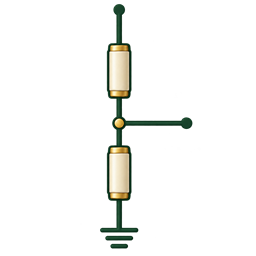
Vout = Vin × R₂ / (R₁ + R₂)Calculations stay in your browser. Share links contain the input values you choose to share.
How to use this calculator
- Enter the source voltage and select its unit.
- Enter the upper resistor R1 and lower resistor R2.
- Read the output voltage, divider current, and power dissipation.
- Enable the load resistor to include its effect on the output.
A quick worked example
With a 12 V input, R1 = 10 kΩ and R2 = 5 kΩ, the unloaded output is 4 V. The divider current is 0.8 mA. Connecting a 10 kΩ load reduces the output to 3 V.
A few useful answers
Why does connecting a load change the output?
The load is in parallel with R2, reducing the lower leg’s effective resistance. The calculator uses R2 ∥ RL in the divider equation.
Can I find a resistor for a target voltage?
Yes. Choose “Find R2 for a target voltage”, enter Vin, R1, and a target below Vin. The result is an ideal resistance; select an available component and recheck the output in analysis mode.
Can a divider power another circuit?
A resistor divider is generally used for signals or biasing. Its output depends on load resistance, so it does not regulate voltage for a changing load. Use a suitable regulator or buffer where required.
Model & assumptions: Ideal resistors and a stiff voltage source. Component tolerances, input leakage, and dynamic loads are not modeled.
Electronics Tools & Calculator
Also available for iOS, Android, and Windows.