Series Capacitor Calculator
Calculate series capacitance, ideal voltage division, charge, and stored energy.
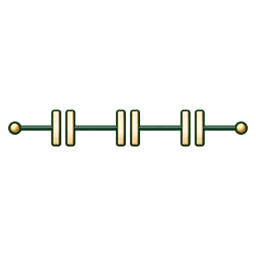
1 / Ctotal = 1 / C₁ + 1 / C₂ + …Calculations stay in your browser. Share links contain the input values you choose to share.
How to use this calculator
- Enter at least two capacitance values, using pF, nF, µF, mF, or F for each.
- Add or remove capacitors, up to a maximum of 12.
- Read the equivalent capacitance.
- Optionally enter an applied voltage to calculate stored charge and energy.
A quick worked example
A 10 µF capacitor in series with a 20 µF capacitor gives 6.6667 µF. With an applied 12 V, the ideal charge on each is 80 µC; voltages are 8 V and 4 V. Total stored energy is 480 µJ.
A few useful answers
Why is series capacitance smaller than each component?
For a given charge, the individual capacitor voltages add. The resulting equivalent capacitance is the reciprocal of the sum of individual reciprocals, which is smaller than the smallest positive capacitance.
How is voltage shared in series?
For ideal capacitors starting uncharged with electrically isolated intermediate nodes, each stores the same charge magnitude. Each voltage is Q/C, so the smaller capacitor has the larger voltage.
Can I add the voltage ratings?
This tool does not determine a permissible bank voltage. Real voltage sharing depends on capacitance tolerances, initial charge, leakage and balancing arrangements. Check the actual capacitor voltages and the manufacturer’s guidance.
Model & assumptions: Ideal initially uncharged capacitors with no intermediate-node loads or leakage. Initial charge, tolerances, balancing networks, ESR, ESL, dielectric absorption and component voltage ratings are not modeled.
Electronics Tools & Calculator
Also available for iOS, Android, and Windows.