SMD Resistor Code Calculator
Decode 3-digit, 4-digit, R-decimal, and EIA-96 resistor markings into ohms, kΩ, and MΩ.
R (Ω) = significant digits × multiplierCalculations stay in your browser. Share links contain the input values you choose to share.
How to use this calculator
- Enter the resistor’s value marking, or try an example.
- Use Auto detect, or choose the marking format from its datasheet.
- Read the resistance and decoding breakdown.
- Optionally select the known tolerance to calculate its nominal limits.
A quick worked example
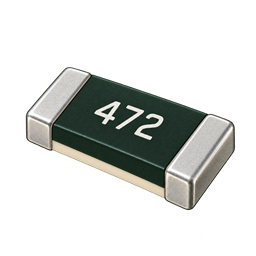
472 gives 4.7 kΩ. The four-digit marking 1001 gives 100 × 10 = 1 kΩ. For EIA-96, 01C uses index 01 = 100 and C = ×100, giving 10 kΩ. With a user-selected ±1% tolerance, its limits are 9.9–10.1 kΩ.
A few useful answers
How do numeric and EIA-96 codes differ?
Numeric markings directly encode two or three significant digits followed by a power-of-ten multiplier. EIA-96 uses an index from 01 to 96 to look up a three-digit E96 value, followed by a letter multiplier.
What does R mean?
Within an R-decimal marking, R replaces the decimal point in ohms: 4R7 = 4.7 Ω and R100 = 0.1 Ω. A final R can also be an EIA-96 multiplier. If both formats fit, Auto detect asks you to choose rather than assume.
What do 0, 00, 000, and 0000 mean?
They represent a nominal zero-ohm jumper in this decoder. An actual jumper has a small nonzero resistance and a finite current rating. Percentage tolerance limits are omitted for jumpers.
Can I infer tolerance or power from the code?
Three-digit codes are often associated with 5% parts, and four-digit/EIA-96 codes with precision parts, but this is not sufficient to establish a particular component’s tolerance. Enter the datasheet tolerance for limits. Wattage, voltage, and current ratings require the part specification.
Which EIA-96 multiplier letters are supported?
Z ×0.001; Y or R ×0.01; X or S ×0.1; A ×1; B or H ×10; C ×100; D ×1,000; E ×10,000; F ×100,000. Letters are accepted in either case. Check manufacturer-specific marking schemes.
Model & assumptions: Common resistor value-marking conventions only. Unmarked chips, low-ohm manufacturer codes using other letters, and full part numbers need the component datasheet. Tolerance is a user-supplied input, not inferred from the marking.
References: Bourns numeric and EIA-96 marking table ↗; Bourns precision resistor marking ↗; DigiKey code formats ↗.
Electronics Tools & Calculator
Also available for iOS, Android, and Windows.