Parallel Resistor Calculator
Find equivalent resistance, total current, and individual branch currents.
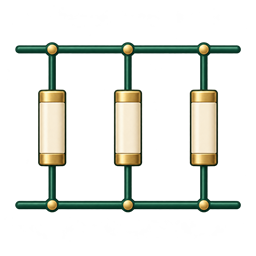
Rtotal = 1 / (1/R₁ + 1/R₂ + …)Calculations stay in your browser. Share links contain the input values you choose to share.
How to use this calculator
- Enter at least two resistor values with their units.
- Add up to 12 parallel branches as needed.
- Read the equivalent resistance and total conductance.
- Enable branch currents and enter a supply voltage to calculate current and power.
A quick worked example
A 1 kΩ resistor in parallel with a 2 kΩ resistor gives 666.67 Ω. At 12 V, the branch currents are 12 mA and 6 mA, giving a total current of 18 mA and total dissipation of 216 mW.
A few useful answers
Why is the result smaller than every resistor?
Parallel branches provide additional paths for current. Their conductances add, so the equivalent resistance is lower than the smallest individual resistance.
What happens with identical resistors?
For N identical resistors, the equivalent resistance is the individual resistance divided by N. Two 1 kΩ resistors in parallel give 500 Ω.
Is the current the same in every branch?
The voltage is the same across all parallel branches. Each branch current is V/R, so smaller resistances carry more current.
Model & assumptions: Ideal resistors connected across the same two nodes. Wiring resistance, component tolerances, and source limits are not modeled.
Electronics Tools & Calculator
Also available for iOS, Android, and Windows.