Inverting Op-Amp Calculator
Solve output voltage, input voltage, gain, or either resistor in an inverting amplifier.
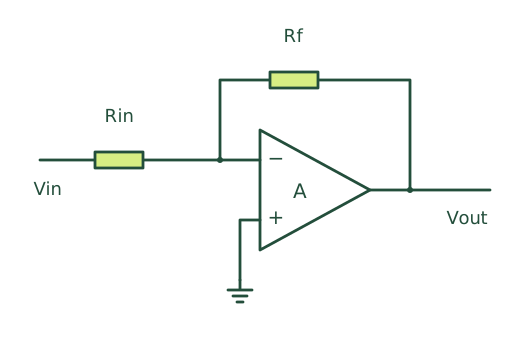
Vout = −Vin × Rf / RinCalculations stay in your browser. Share links contain the input values you choose to share.
How to use this calculator
- Choose output voltage, input voltage, voltage gain, Rin, or Rf as the unknown.
- Enter the known values and units. Voltage values may be positive, negative, or zero.
- For resistor design, use an input/output voltage pair or enter a negative target gain.
- Read the result and the updated resistor and voltage labels in the circuit.
A quick worked example
With Vin = 0.2 V, Rin = 10 kΩ and Rf = 100 kΩ, Av = −10 V/V and Vout = −2 V. To design for Av = −5 using Rin = 10 kΩ, solve Rf using target gain: Rf = 50 kΩ.
A few useful answers
Why is the gain negative?
The signal enters the inverting input through Rin. The output polarity reverses relative to the input. The non-inverting input is grounded in this circuit.
Can I solve for a resistor?
Yes. Select Rin or Rf, then choose a known input/output voltage pair or a target gain. Positive resistors require a negative gain.
Why does 0 V input and 0 V output not determine a resistor?
Those voltages are compatible with every finite gain in this ideal circuit. They do not identify one resistor ratio. Enter a nonzero input or choose target gain.
Model & assumptions: Ideal op-amp with negative feedback, infinite open-loop gain and input impedance, and zero output impedance. Positive finite resistors and signed DC voltages. Supply rails, output swing, input common-mode limits, offset, bias current, loading, bandwidth and slew rate are not modeled. Check the real device datasheet for linear operation.
Electronics Tools & Calculator
Also available for iOS, Android, and Windows.