Non-Inverting Op-Amp Calculator
Find output voltage, input voltage, gain, feedback resistance, or ground resistance.
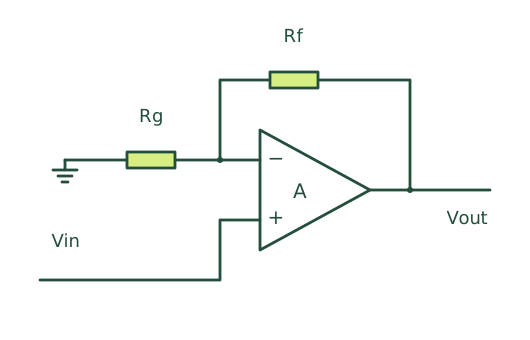
Vout = Vin × (1 + Rf / Rg)Calculations stay in your browser. Share links contain the input values you choose to share.
How to use this calculator
- Choose output voltage, input voltage, gain, feedback resistor Rf, or ground resistor Rg.
- Enter the known signed voltages and positive resistor values.
- For resistor design, select voltage-pair or target-gain input. The gain must exceed 1.
- Read the solved value, closed-loop gain, and live circuit labels.
A quick worked example
With Vin = 0.2 V, Rg = 10 kΩ and Rf = 100 kΩ, Av = 11 V/V and Vout = 2.2 V. A gain of 3 with Rg = 10 kΩ requires Rf = 20 kΩ.
A few useful answers
Why is the gain greater than one?
For positive finite Rf and Rg, Av = 1 + Rf/Rg is greater than 1. A unity-gain voltage follower uses a direct feedback connection and is a different topology.
What is the ground resistor?
Rg connects the inverting input to ground. Rf connects the output to the inverting input. The input signal goes directly to the non-inverting input.
Does a negative input work?
Yes. The ideal output has the same polarity as the input. A real circuit needs suitable supply voltages and input/output operating ranges.
Model & assumptions: Ideal op-amp with negative feedback, infinite open-loop gain and input impedance, and zero output impedance. Positive finite resistors and signed DC voltages. Supply rails, output swing, input common-mode limits, offset, bias current, loading, bandwidth and slew rate are not modeled. Check the real device datasheet for linear operation.
Reference: Texas Instruments — non-inverting amplifier circuit ↗
Electronics Tools & Calculator
Also available for iOS, Android, and Windows.